
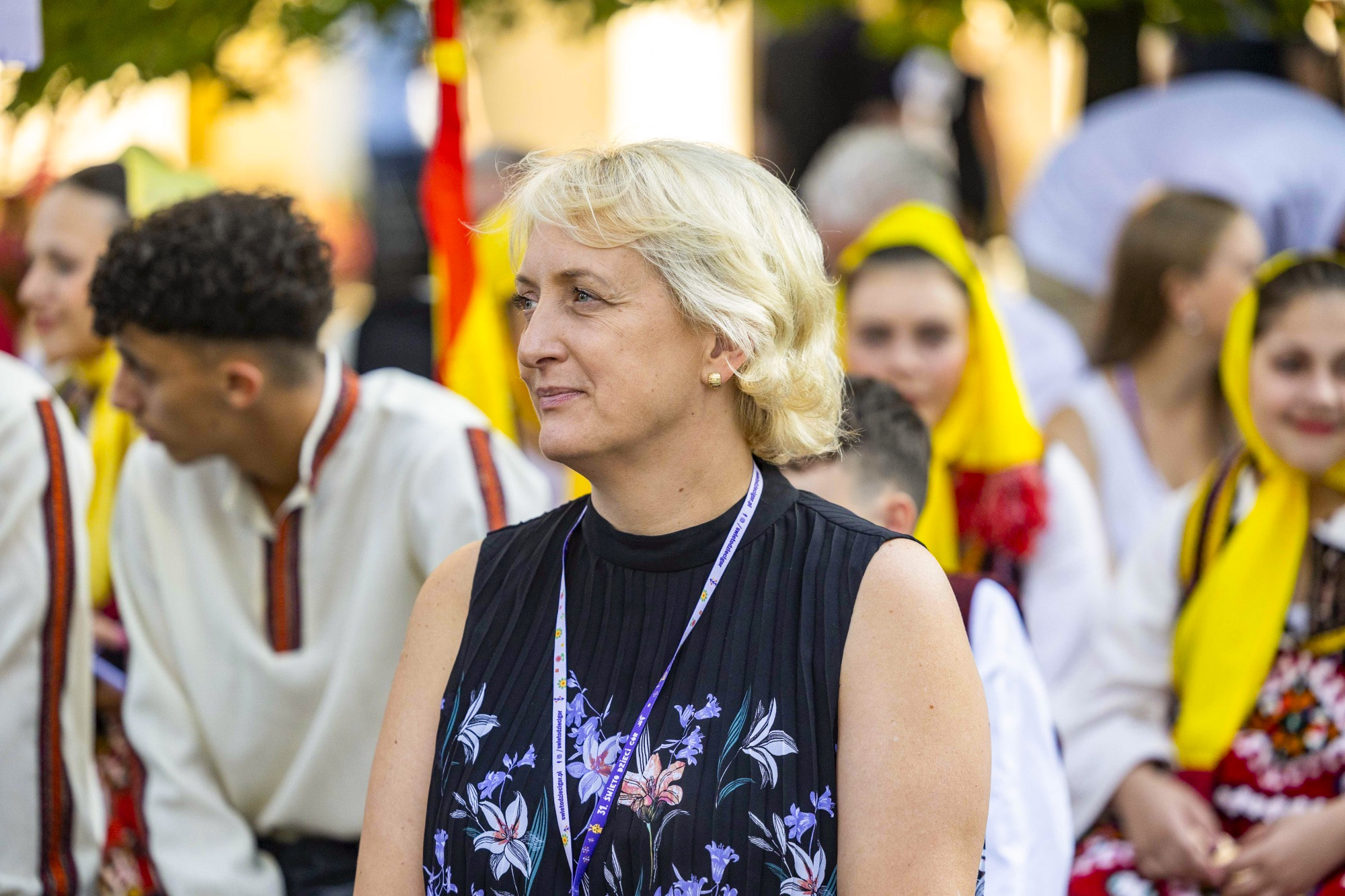
After 15 years on the Artistic Council of FESTIVAL OF THE CHILDREN OF MOUNTAINS, Dr Dorota Majerczyk cannot remember exactly how many times she has served as its president. However, she knows perfectly well what the heart of the festival is: ‘To appreciate, not to judge.’ In a conversation about children's folklore, the challenges faced by contemporary instructors and the phenomenon of intercultural encounters, she reveals why the most valuable qualities in the Artistic Council are... modesty and a constant willingness to learn from others.
Kamil Cyganik talks to Dr Dorota Majerczyk, Chair of the Artistic Council of the 32nd FESTIVAL OF THE CHILDREN OF MOUNTAINS.
Kamil Cyganik: How many times have you been Chairwoman of the Artistic Council?
Dorota Majerczyk: I don't remember. This is my fifteenth term on the Council, although my adventure with the MOUNTAIN CHILDREN'S FESTIVAL began a little earlier, in 1999. That was when I first had the opportunity to meet the Artistic Council as the leader of the ROBCUSIE ensemble from Rabka. The words of Mira Bobrowska, Peter Homolka and Aleksandra Szurmiak-Bogucka had a real impact on my interests and also on my life choices. These were people who inspired me with their approach to children's folklore, looking at it not only through the lens of dance and song, but also through the lens of folk tales (theatre), in which children present images and scenes of children's customs, thanks to which the younger generation can learn something about the lives of their ancestors, how our great-grandparents, grandparents and fathers spent their time...
K.C.: Do you remember anything from that meeting?
D.M.: Peter Homolka said that our programme took him back to his childhood, that it was such a beautiful performance that he felt like a little child again! I was thrilled! As they say, it ‘gave me wings’. I thought: it's worth doing! People like it! It's worth the effort. Once again, I emphasise how important motivation is for fieldwork! It encourages you to do research, studies... and raise awareness.
K.C.: Then, I remember, you gave morning presentations in front of the town hall.
D.M.: Yes, it was a very pleasant task. Sometimes I meet people from Nowy Sącz who remember me. At that time, I had already started studying ethnology (Department of General and Applied Folklore) at the University of Silesia in Cieszyn. Education in this field broadened my worldview and allowed me to open up to other cultures. Before that, I had a much narrower view – you could say I couldn't see beyond the end of my nose. The most important thing for me was my small homeland, my dancing, singing and music, my space, and other regions – they were... well, they were somewhere in the background. Thanks to my studies, I began to observe people more closely, not to categorise them, but to try to understand that being different is not worse, on the contrary – it can be better! I happen to live at the intersection of different regions. This allows me to observe a colourful cultural mosaic: Zagórzans, Kliszczakows, Podhalans, and I am not far from Babiogórcy or Orawiaks. I can continue to discover the beauty of differences.
K.C.: Respect for diversity?
D.M.: Yes, ethnology is the study of people, their lives and cultures, a science that allows us to open ourselves up to diversity regardless of race, language or religion. It allows us to immerse ourselves in learning and discovery, which is why today I see every person as valuable.
K.C.: But surely it's not just your studies that teach you that?
D.M.: Of course not, but they certainly help. My participation in regional groups and festivals such as FESTIVAL OF THE CHILDREN OF MOUNTAINS gave me a sense of appreciation for my own identity, but also opportunities to meet peers with similar interests. In particular, spending time with other children brought a lot of joy, friendship and respect for others into my life.
K.C.: Also in understanding who the child is?
D.M.: Yes. I was able to observe the child, his behaviour among other children, his directness, his open heart, and approach him – as Józek Broda said – with an open hand. Children here get to know each other, play together, without barriers, sometimes they don't know the language, but it doesn't bother them at all. I consider this a phenomenon. As the manager of the MAJERANKA regional ensemble (which has been to the Nowy Sącz Festival three times), I had the opportunity to observe this extraordinary and unique environment. I also met many folklore enthusiasts and leaders of children's ensembles. When travelling to countries such as Turkey, I was not afraid that our children would be staying in Turkish homes. The parents were more concerned about their children staying in Muslim homes. Meanwhile, the hosts wanted to give them the world! With my group, I travelled to many interesting places around the world. We were in Peru, Mexico, Ecuador and Chile (the latter with a group we met at the FESTIVAL OF THE CHILDREN OF MOUNTAINS festival in 1999). Conditions in South America are often difficult, but I was not afraid, because this Festival taught me to be open to others, to have childlike trust and faith in other people. It helps and stays with you.
K.C.: Returning to the Artistic Council...
D.M.: When I finished my studies and my adventure as an announcer at the Town Hall, I was invited to join the Council as a secretary. I took notes and helped in any way I could, but the most important thing for me was participating in programme discussions.
K.C.: What did you gain from that time?
D.M.: All the analyses, valuable tips, sometimes even full of spirituality, such as Pedro's observations...
K.C.: I expected that name to come up...
D.M.: He was able to notice things that others couldn't quite see, because he looked at things not only through the eyes of a cultural anthropologist, but also as a teacher and educator. He noticed things that were almost sacred, spiritual. I learned a lot from Aleksandra Szurmiak-Bogucka, who was my mentor in everything. To this day, I still use her methodology and apply the knowledge she passed on to me. Benedykt Kafel has been on the Council from the very beginning and is a great authority for me. The jury included Janka Kalicińska, Mira Bobrowska and many other wonderful people, thanks to whom I am where I am today.
K.C.: Would I be wrong to say that I sense great gratitude in you?
D.M.: Yes, gratitude, and the second word is ‘humility’.
K.C.: What do you meant by that?
D.M.: Constantly gaining knowledge, not only theoretical but also practical, even from instructors who have been coming to the Festival for years, because in fact they bring a piece of their world and their own culture with them. It is impossible for the Council to know everything, so often, in addition to answers, questions are asked.
K.C.: For example?
D.M.: Today I asked if the Basque dance with sticks performed yesterday by the girls was authentic. It turned out that it wasn't, but they have more girls (seventeen and only three boys) and they wanted to show this particular dance.
K.C.: A sign of the times?
D.M.: Perhaps. Maybe one day girls will have to dance the zbójnicki (I'm joking, of course). Today, we see more girls in bands. Yesterday, there were no boys playing in MAŁE JURKOWIANY, which used to be unthinkable. In traditional bands, it was mostly men who played (with a few exceptions).
K.C.: As president of the Artistic Council, what tasks would you set for the team leaders in view of these changing times?
D.M.: The most important thing is for them to be aware, because this awareness will help them prepare children's assemblies at the right time and in the right place. Thanks to this awareness, they will be able to distinguish between falsehood and truth. Of course, the world is changing and children today do not herd cows. And which child knows what a haystack is, since hay is baled? If an instructor decides to show a performance that takes place in a clearing by a stream, they should explore the topic of pastoral culture. For children, herding geese or cattle is science fiction. It is up to the managers to decide how they will convey to children what it was like in the past, how our grandparents played, in what space, what their games, dances, songs, speech and costumes were like. Not everyone knows that there were once orphan songs that seem relevant in today's world... It is possible to beautifully weave them into the programme and present a boy and a girl singing songs about longing for their mother or father. It is also possible to introduce songs for children into the programme, e.g. lullabies passed down from generation to generation, usually hummed by grandmothers. Children's games and activities are based on narrow range melodies, which at first glance seem easy, but here too, care must be taken to ensure that they are sung clearly in the right key and metre. It is worth looking for and presenting various elements of children's folklore, such as riddles, counting rhymes, gesture rhymes, etc., which have their origins in ancient cultures. The programmes enrich props typical of a child's environment, e.g. wooden toys, rag dolls or balls made of forest cones, a piece of string that can be used as a skipping rope. It should not be forgotten that language and dialect are important in these games. Often, children called by name in the programmes are not called Antoni but Jantek, not Agnieszka but Jagniesia, etc. A conscious instructor must know that text is important during games, so the programme must be prepared with language in mind. We want children to be children, to play freely, but we must not forget that they are on stage, in front of an audience that is listening and watching. The texts should be understandable and clear.
K.C.: Especially here, where, in my opinion, the stage does not help; even sitting in the front row, there are many things I do not understand.
D.M.: You have to remember that the stage has its own requirements and pay attention to ensure that the articulation is as good as possible. And here we come to another area, which is directing, so that the programme has its own logic. A perfect example from yesterday is the accordionist, Stryk. His arrival was more authentic than the appearance of the whole band in full costume. And the child always had the role of asking, it couldn't order an adult to do anything, but rather should have expressed gratitude that someone had paid attention to it. Such were the relationships based on respect in the past. The child was grateful that his mother or sister brought him some food to the pasture, that he got anything to eat. These are realities that children today have no idea about.
K.C.: A lot of work for the instructors...
D.M.: Then we appreciate, for example, the shepherds' calls of the MAŁYCH JURKOWIAN.
K.C.: And the programme about healing?
D.M.: Highlighting ethnographic elements in programmes, such as healing, in this case applying common plantain to wounds, is an example of drawing on topics related to folk medicine and beliefs, because you had to believe that it would help, you had to have faith in words, which in turn have the power to cause things to happen: praise be to...
K.C.: Exactly: who?
D.M.: Yes, Jesus Christ, you have to say it all the way... God be with you! God bless you! You wished someone God's blessing on their farm. It was very important, but today it is forgotten. Or even in such chants: ‘Little ladybird, fly up to heaven, bring me a piece of bread!’ It wasn’t just a saying. People believed that this little ladybird would make the hunger disappear.
K.C.: And this was often said by people who were really hungry...
D.M.: Yes. These cries: Shine on me, sun, because I'm cold. Blow, wind, dry my clothes. Children often turned to natural and atmospheric phenomena, or to their mummy or daddy, to express their discomfort. Which is why they were so happy to see other children coming to them and having the opportunity to play. To spend time together and, in fact, share their joys and sorrows.
K.C.: What else does the Council pay attention to in its appreciation of their work?
D.M.: For example, the order and dance technique. There are certain canons that must be observed.
K.C.: For example?
D.M.: Here in Podhale, it is the rule that a boy should ‘invite’ his partner, i.e. lead her out to dance. Some people take shortcuts and the girls immediately go out to dance with the boys. We are here to make sure that the order of figures, steps and gestures is maintained, so that individual elements are not degraded, because then they will be lost.
K.C.: Festive costumes?
D.M.: They must also have their justification on stage. In the case of artistically developed programmes based solely on singing and dancing, they are justified. Benedykt Kafel often talked about clothing in a cultural context. He recalled that in the 1970s, children dressed in festive clothing appeared at festivals and were copies of adults. Today, these modest and varied garments, children's clothes, emphasise the truth of what a child actually looked like.
K.C.: After all, children were not dressed in expensive clothes that they would outgrow in a year or two...
D.M.: Of course, even ordinary clothes were sometimes patched, sometimes too long, sometimes just a shirt without trousers. It depended on what people could afford. And after 32 years of hard work, the jury succeeded. The children are beautifully and traditionally dressed, with age appropriate texts and dances suited to their abilities. For example, we cannot expect a small child to dance a zbójnicki dance with weapons and axes.
K.C.: How would you explain the necessity of such a methodology?
D.M.: It is an educational process, a process of learning from easier to very difficult steps. Certain things cannot be skipped. It takes time. You cannot rush children, because you will demotivate them. The child will become discouraged. Today, when there are so many opportunities to spend free time, you have to take a slightly different approach. In the past, it was often only the band that gave them the opportunity to travel abroad. Today? Parents take their children and travel all over the world.
K.C.: I think it's fair to say that children in Tanzania are now in the same situation you were in several decades ago. How do you perceive this group?
D.M.: I was there once. And what captivated me about the performance of the children from Tanzania? I felt the atmosphere of the African land. Those primitive instruments, for which they deserve praise (because sometimes they bring plastic ones), create the atmosphere of primitive tribal music. A wooden xylophone, drums... Playing these very simple instruments transported me to a completely different cultural circle. The children’s stamping, like in the Maasai tribes, was also very primal. The leaps, which traditionally were meant to spot wild animals, to check if any danger was approaching the cows they were herding. It really moved me. Sometimes they danced to each other, no one told them to, the priest had only just started working with them, so it's in their blood, it's in them. It comes from their culture, from their upbringing in the culture of Masai herders. The primitive clothing, especially the boys’, was something fantastic. I’m very glad they came here, though it was probably a culture shock for them.
K.C.: At the meeting at SOKÓL on the first day of the Festival, you said something very beautiful: that the Artistic Council is there to appreciate, not to judge…
D.M.: Especially nowadays. Neither I nor any of the judges will travel to any region to lead a team... and it is very easy to demotivate people. We must appreciate the work of people who, despite everything, despite pressure, mass culture, despite fashion, preserve in their small homelands that part of tradition passed down from generation to generation. They are our hope. I won't be here for much longer. Someone else will take my place. I am not attached to it. But while I am here, I would like to share as much as I can, as much as I have received, with the instructors, especially the Polish ones, to give them tips, advice, and all of my colleagues on the Council have the same attitude. For me, it is an honour to sit on the Council with these people.
K.C.: So who are they? Who else is on the Council at this year's FESTIVAL OF THE CHILDREN OF MOUNTAINS?
D.M.: On the Polish side, there is Benedykt Kafel, who contributes many valuable comments on rural customs, clothing and its aesthetics, rituals, etc. Tomasz Nowak is very open to children who play and dance in bands, always smiling and warm. He is a choreologist, musicologist, plays the violin, and can appreciate and advise on musical and dance issues, such as articulation and voice production. For example, he can pick up on the characteristic manner of singing through the nose that is common today and suggest a way of working on it. And I know from my own experience that Tomasz Nowak is a source of inspiration. I took part in the Ethnomusicology Course he led at the University of Warsaw. It was he who encouraged me to broaden my knowledge in the field of ethnomusicology. At his urging, I completed a PhD in this field. Evgeniya Grancharova from Bulgaria comes from a tradition of instructors and wonderful Bulgarian dancers, and has experience in leading a troupe. Practical knowledge alongside theoretical knowledge is invaluable. Evgeniya, who has been teaching dance for years, discusses performances in a warm, calm, measured and kind manner, because she is a good woman, an angel of a woman. Bariş Kop is with us for the first time; he organises children’s festivals in Turkey, in which I have had the chance to take part. He approaches children with a huge heart. At first he was very nervous, but then... What details he pays attention to! I didn’t tell my highlander groups that their shirts were sticking out of their trousers, but Baris pointed it out to them in such a way that they all started laughing and agreed with him. He has a cheerful nature. Today he said to the Basques: ‘I hate you…’. And when they froze in alarm, he added: “Because you have such wonderful music and technique…”. Laura Viviana López Cristancho has keen insights; she sometimes asks questions and compares things with her own circle. She is very inquisitive, open and kind.
K.C.: If you were to advise teachers, what would you say based on your many years’ experience as an instructor and ensemble director?
D.M.: You have to take an individual approach with every child. For example, if a child has acting talent but poor dance technique, it’s worth being very patient and waiting for them to open up; instructors sometimes give up on them unnecessarily. Of course, if they have absolutely no sense of pitch, there’s nothing we can do, but if they can hear but sing uncertainly, we need to wait – perhaps their range is only just developing? We need to be patient but consistent.
K.C.: When I began my journey with the Festival in 2005, taking part in the Instructors’ Workshops was incredibly valuable to me. Isn’t it a shame they’re no longer held?
D.M.: Many people were trained at those workshops. However, SOKÓŁ now organises masterclasses for instructors of regional ensembles, which consist of practical sessions and theoretical lectures. Such courses are held in various regions of Małopolska. I’ve had the pleasure of participating in them as a lecturer. I shared my knowledge about children's folklore. These courses include classes in ethnography and choreography, e.g. dance workshops conducted by locals. There are also voice training and practical classes on children's games and physical activities.
K.C.: Are there any other places, apart from our Festival, where children can showcase their cultural identity? Not just dancing, but also games, chants, counting rhymes and customs?
D.M.: There is the Carpathian Festival of Children’s Regional Ensembles in Rabka. It predates our Festival, and there the ensembles perform exclusively folk scenes. Guest ensembles come to present a programme in the artistically choreographed category. Qualifying rounds for the Carpathian festival take place during cultural events in the respective towns. For example: in Zakopane, there is ‘Złote kierpce’ (Golden Clogs), in Babiogórcy there is the Review of Children's Regional Ensembles in Maków Podhalański, where ensembles are nominated for Rabka, Krakowiaczek in Łoniowa, or reviews in Spisz. These performances are first presented at these regional reviews, then in Rabka, and from there we send them to the FESTIVAL OF THE CHILDREN OF MOUNTAINS. This is where the main concert takes place after all the necessary consultations. It should be added that this year’s performances by Polish groups have been enhanced with artistically choreographed dance and vocal displays, which make the Festival more appealing and are well received by the audience.
K.C.: Thank you very much for your time.
Kamil Cyganik: How many times have you been Chairwoman of the Artistic Council?
Dorota Majerczyk: I don't remember. This is my fifteenth term on the Council, although my adventure with the MOUNTAIN CHILDREN'S FESTIVAL began a little earlier, in 1999. That was when I first had the opportunity to meet the Artistic Council as the leader of the ROBCUSIE ensemble from Rabka. The words of Mira Bobrowska, Peter Homolka and Aleksandra Szurmiak-Bogucka had a real impact on my interests and also on my life choices. These were people who inspired me with their approach to children's folklore, looking at it not only through the lens of dance and song, but also through the lens of folk tales (theatre), in which children present images and scenes of children's customs, thanks to which the younger generation can learn something about the lives of their ancestors, how our great-grandparents, grandparents and fathers spent their time...
K.C.: Do you remember anything from that meeting?
D.M.: Peter Homolka said that our programme took him back to his childhood, that it was such a beautiful performance that he felt like a little child again! I was thrilled! As they say, it ‘gave me wings’. I thought: it's worth doing! People like it! It's worth the effort. Once again, I emphasise how important motivation is for fieldwork! It encourages you to do research, studies... and raise awareness.
K.C.: Then, I remember, you gave morning presentations in front of the town hall.
D.M.: Yes, it was a very pleasant task. Sometimes I meet people from Nowy Sącz who remember me. At that time, I had already started studying ethnology (Department of General and Applied Folklore) at the University of Silesia in Cieszyn. Education in this field broadened my worldview and allowed me to open up to other cultures. Before that, I had a much narrower view – you could say I couldn't see beyond the end of my nose. The most important thing for me was my small homeland, my dancing, singing and music, my space, and other regions – they were... well, they were somewhere in the background. Thanks to my studies, I began to observe people more closely, not to categorise them, but to try to understand that being different is not worse, on the contrary – it can be better! I happen to live at the intersection of different regions. This allows me to observe a colourful cultural mosaic: Zagórzans, Kliszczakows, Podhalans, and I am not far from Babiogórcy or Orawiaks. I can continue to discover the beauty of differences.
K.C.: Respect for diversity?
D.M.: Yes, ethnology is the study of people, their lives and cultures, a science that allows us to open ourselves up to diversity regardless of race, language or religion. It allows us to immerse ourselves in learning and discovery, which is why today I see every person as valuable.
K.C.: But surely it's not just your studies that teach you that?
D.M.: Of course not, but they certainly help. My participation in regional groups and festivals such as FESTIVAL OF THE CHILDREN OF MOUNTAINS gave me a sense of appreciation for my own identity, but also opportunities to meet peers with similar interests. In particular, spending time with other children brought a lot of joy, friendship and respect for others into my life.
K.C.: Also in understanding who the child is?
D.M.: Yes. I was able to observe the child, his behaviour among other children, his directness, his open heart, and approach him – as Józek Broda said – with an open hand. Children here get to know each other, play together, without barriers, sometimes they don't know the language, but it doesn't bother them at all. I consider this a phenomenon. As the manager of the MAJERANKA regional ensemble (which has been to the Nowy Sącz Festival three times), I had the opportunity to observe this extraordinary and unique environment. I also met many folklore enthusiasts and leaders of children's ensembles. When travelling to countries such as Turkey, I was not afraid that our children would be staying in Turkish homes. The parents were more concerned about their children staying in Muslim homes. Meanwhile, the hosts wanted to give them the world! With my group, I travelled to many interesting places around the world. We were in Peru, Mexico, Ecuador and Chile (the latter with a group we met at the FESTIVAL OF THE CHILDREN OF MOUNTAINS festival in 1999). Conditions in South America are often difficult, but I was not afraid, because this Festival taught me to be open to others, to have childlike trust and faith in other people. It helps and stays with you.
K.C.: Returning to the Artistic Council...
D.M.: When I finished my studies and my adventure as an announcer at the Town Hall, I was invited to join the Council as a secretary. I took notes and helped in any way I could, but the most important thing for me was participating in programme discussions.
K.C.: What did you gain from that time?
D.M.: All the analyses, valuable tips, sometimes even full of spirituality, such as Pedro's observations...
K.C.: I expected that name to come up...
D.M.: He was able to notice things that others couldn't quite see, because he looked at things not only through the eyes of a cultural anthropologist, but also as a teacher and educator. He noticed things that were almost sacred, spiritual. I learned a lot from Aleksandra Szurmiak-Bogucka, who was my mentor in everything. To this day, I still use her methodology and apply the knowledge she passed on to me. Benedykt Kafel has been on the Council from the very beginning and is a great authority for me. The jury included Janka Kalicińska, Mira Bobrowska and many other wonderful people, thanks to whom I am where I am today.
K.C.: Would I be wrong to say that I sense great gratitude in you?
D.M.: Yes, gratitude, and the second word is ‘humility’.
K.C.: What do you meant by that?
D.M.: Constantly gaining knowledge, not only theoretical but also practical, even from instructors who have been coming to the Festival for years, because in fact they bring a piece of their world and their own culture with them. It is impossible for the Council to know everything, so often, in addition to answers, questions are asked.
K.C.: For example?
D.M.: Today I asked if the Basque dance with sticks performed yesterday by the girls was authentic. It turned out that it wasn't, but they have more girls (seventeen and only three boys) and they wanted to show this particular dance.
K.C.: A sign of the times?
D.M.: Perhaps. Maybe one day girls will have to dance the zbójnicki (I'm joking, of course). Today, we see more girls in bands. Yesterday, there were no boys playing in MAŁE JURKOWIANY, which used to be unthinkable. In traditional bands, it was mostly men who played (with a few exceptions).
K.C.: As president of the Artistic Council, what tasks would you set for the team leaders in view of these changing times?
D.M.: The most important thing is for them to be aware, because this awareness will help them prepare children's assemblies at the right time and in the right place. Thanks to this awareness, they will be able to distinguish between falsehood and truth. Of course, the world is changing and children today do not herd cows. And which child knows what a haystack is, since hay is baled? If an instructor decides to show a performance that takes place in a clearing by a stream, they should explore the topic of pastoral culture. For children, herding geese or cattle is science fiction. It is up to the managers to decide how they will convey to children what it was like in the past, how our grandparents played, in what space, what their games, dances, songs, speech and costumes were like. Not everyone knows that there were once orphan songs that seem relevant in today's world... It is possible to beautifully weave them into the programme and present a boy and a girl singing songs about longing for their mother or father. It is also possible to introduce songs for children into the programme, e.g. lullabies passed down from generation to generation, usually hummed by grandmothers. Children's games and activities are based on narrow range melodies, which at first glance seem easy, but here too, care must be taken to ensure that they are sung clearly in the right key and metre. It is worth looking for and presenting various elements of children's folklore, such as riddles, counting rhymes, gesture rhymes, etc., which have their origins in ancient cultures. The programmes enrich props typical of a child's environment, e.g. wooden toys, rag dolls or balls made of forest cones, a piece of string that can be used as a skipping rope. It should not be forgotten that language and dialect are important in these games. Often, children called by name in the programmes are not called Antoni but Jantek, not Agnieszka but Jagniesia, etc. A conscious instructor must know that text is important during games, so the programme must be prepared with language in mind. We want children to be children, to play freely, but we must not forget that they are on stage, in front of an audience that is listening and watching. The texts should be understandable and clear.
K.C.: Especially here, where, in my opinion, the stage does not help; even sitting in the front row, there are many things I do not understand.
D.M.: You have to remember that the stage has its own requirements and pay attention to ensure that the articulation is as good as possible. And here we come to another area, which is directing, so that the programme has its own logic. A perfect example from yesterday is the accordionist, Stryk. His arrival was more authentic than the appearance of the whole band in full costume. And the child always had the role of asking, it couldn't order an adult to do anything, but rather should have expressed gratitude that someone had paid attention to it. Such were the relationships based on respect in the past. The child was grateful that his mother or sister brought him some food to the pasture, that he got anything to eat. These are realities that children today have no idea about.
K.C.: A lot of work for the instructors...
D.M.: Then we appreciate, for example, the shepherds' calls of the MAŁYCH JURKOWIAN.
K.C.: And the programme about healing?
D.M.: Highlighting ethnographic elements in programmes, such as healing, in this case applying common plantain to wounds, is an example of drawing on topics related to folk medicine and beliefs, because you had to believe that it would help, you had to have faith in words, which in turn have the power to cause things to happen: praise be to...
K.C.: Exactly: who?
D.M.: Yes, Jesus Christ, you have to say it all the way... God be with you! God bless you! You wished someone God's blessing on their farm. It was very important, but today it is forgotten. Or even in such chants: ‘Little ladybird, fly up to heaven, bring me a piece of bread!’ It wasn’t just a saying. People believed that this little ladybird would make the hunger disappear.
K.C.: And this was often said by people who were really hungry...
D.M.: Yes. These cries: Shine on me, sun, because I'm cold. Blow, wind, dry my clothes. Children often turned to natural and atmospheric phenomena, or to their mummy or daddy, to express their discomfort. Which is why they were so happy to see other children coming to them and having the opportunity to play. To spend time together and, in fact, share their joys and sorrows.
K.C.: What else does the Council pay attention to in its appreciation of their work?
D.M.: For example, the order and dance technique. There are certain canons that must be observed.
K.C.: For example?
D.M.: Here in Podhale, it is the rule that a boy should ‘invite’ his partner, i.e. lead her out to dance. Some people take shortcuts and the girls immediately go out to dance with the boys. We are here to make sure that the order of figures, steps and gestures is maintained, so that individual elements are not degraded, because then they will be lost.
K.C.: Festive costumes?
D.M.: They must also have their justification on stage. In the case of artistically developed programmes based solely on singing and dancing, they are justified. Benedykt Kafel often talked about clothing in a cultural context. He recalled that in the 1970s, children dressed in festive clothing appeared at festivals and were copies of adults. Today, these modest and varied garments, children's clothes, emphasise the truth of what a child actually looked like.
K.C.: After all, children were not dressed in expensive clothes that they would outgrow in a year or two...
D.M.: Of course, even ordinary clothes were sometimes patched, sometimes too long, sometimes just a shirt without trousers. It depended on what people could afford. And after 32 years of hard work, the jury succeeded. The children are beautifully and traditionally dressed, with age appropriate texts and dances suited to their abilities. For example, we cannot expect a small child to dance a zbójnicki dance with weapons and axes.
K.C.: How would you explain the necessity of such a methodology?
D.M.: It is an educational process, a process of learning from easier to very difficult steps. Certain things cannot be skipped. It takes time. You cannot rush children, because you will demotivate them. The child will become discouraged. Today, when there are so many opportunities to spend free time, you have to take a slightly different approach. In the past, it was often only the band that gave them the opportunity to travel abroad. Today? Parents take their children and travel all over the world.
K.C.: I think it's fair to say that children in Tanzania are now in the same situation you were in several decades ago. How do you perceive this group?
D.M.: I was there once. And what captivated me about the performance of the children from Tanzania? I felt the atmosphere of the African land. Those primitive instruments, for which they deserve praise (because sometimes they bring plastic ones), create the atmosphere of primitive tribal music. A wooden xylophone, drums... Playing these very simple instruments transported me to a completely different cultural circle. The children’s stamping, like in the Maasai tribes, was also very primal. The leaps, which traditionally were meant to spot wild animals, to check if any danger was approaching the cows they were herding. It really moved me. Sometimes they danced to each other, no one told them to, the priest had only just started working with them, so it's in their blood, it's in them. It comes from their culture, from their upbringing in the culture of Masai herders. The primitive clothing, especially the boys’, was something fantastic. I’m very glad they came here, though it was probably a culture shock for them.
K.C.: At the meeting at SOKÓL on the first day of the Festival, you said something very beautiful: that the Artistic Council is there to appreciate, not to judge…
D.M.: Especially nowadays. Neither I nor any of the judges will travel to any region to lead a team... and it is very easy to demotivate people. We must appreciate the work of people who, despite everything, despite pressure, mass culture, despite fashion, preserve in their small homelands that part of tradition passed down from generation to generation. They are our hope. I won't be here for much longer. Someone else will take my place. I am not attached to it. But while I am here, I would like to share as much as I can, as much as I have received, with the instructors, especially the Polish ones, to give them tips, advice, and all of my colleagues on the Council have the same attitude. For me, it is an honour to sit on the Council with these people.
K.C.: So who are they? Who else is on the Council at this year's FESTIVAL OF THE CHILDREN OF MOUNTAINS?
D.M.: On the Polish side, there is Benedykt Kafel, who contributes many valuable comments on rural customs, clothing and its aesthetics, rituals, etc. Tomasz Nowak is very open to children who play and dance in bands, always smiling and warm. He is a choreologist, musicologist, plays the violin, and can appreciate and advise on musical and dance issues, such as articulation and voice production. For example, he can pick up on the characteristic manner of singing through the nose that is common today and suggest a way of working on it. And I know from my own experience that Tomasz Nowak is a source of inspiration. I took part in the Ethnomusicology Course he led at the University of Warsaw. It was he who encouraged me to broaden my knowledge in the field of ethnomusicology. At his urging, I completed a PhD in this field. Evgeniya Grancharova from Bulgaria comes from a tradition of instructors and wonderful Bulgarian dancers, and has experience in leading a troupe. Practical knowledge alongside theoretical knowledge is invaluable. Evgeniya, who has been teaching dance for years, discusses performances in a warm, calm, measured and kind manner, because she is a good woman, an angel of a woman. Bariş Kop is with us for the first time; he organises children’s festivals in Turkey, in which I have had the chance to take part. He approaches children with a huge heart. At first he was very nervous, but then... What details he pays attention to! I didn’t tell my highlander groups that their shirts were sticking out of their trousers, but Baris pointed it out to them in such a way that they all started laughing and agreed with him. He has a cheerful nature. Today he said to the Basques: ‘I hate you…’. And when they froze in alarm, he added: “Because you have such wonderful music and technique…”. Laura Viviana López Cristancho has keen insights; she sometimes asks questions and compares things with her own circle. She is very inquisitive, open and kind.
K.C.: If you were to advise teachers, what would you say based on your many years’ experience as an instructor and ensemble director?
D.M.: You have to take an individual approach with every child. For example, if a child has acting talent but poor dance technique, it’s worth being very patient and waiting for them to open up; instructors sometimes give up on them unnecessarily. Of course, if they have absolutely no sense of pitch, there’s nothing we can do, but if they can hear but sing uncertainly, we need to wait – perhaps their range is only just developing? We need to be patient but consistent.
K.C.: When I began my journey with the Festival in 2005, taking part in the Instructors’ Workshops was incredibly valuable to me. Isn’t it a shame they’re no longer held?
D.M.: Many people were trained at those workshops. However, SOKÓŁ now organises masterclasses for instructors of regional ensembles, which consist of practical sessions and theoretical lectures. Such courses are held in various regions of Małopolska. I’ve had the pleasure of participating in them as a lecturer. I shared my knowledge about children's folklore. These courses include classes in ethnography and choreography, e.g. dance workshops conducted by locals. There are also voice training and practical classes on children's games and physical activities.
K.C.: Are there any other places, apart from our Festival, where children can showcase their cultural identity? Not just dancing, but also games, chants, counting rhymes and customs?
D.M.: There is the Carpathian Festival of Children’s Regional Ensembles in Rabka. It predates our Festival, and there the ensembles perform exclusively folk scenes. Guest ensembles come to present a programme in the artistically choreographed category. Qualifying rounds for the Carpathian festival take place during cultural events in the respective towns. For example: in Zakopane, there is ‘Złote kierpce’ (Golden Clogs), in Babiogórcy there is the Review of Children's Regional Ensembles in Maków Podhalański, where ensembles are nominated for Rabka, Krakowiaczek in Łoniowa, or reviews in Spisz. These performances are first presented at these regional reviews, then in Rabka, and from there we send them to the FESTIVAL OF THE CHILDREN OF MOUNTAINS. This is where the main concert takes place after all the necessary consultations. It should be added that this year’s performances by Polish groups have been enhanced with artistically choreographed dance and vocal displays, which make the Festival more appealing and are well received by the audience.
K.C.: Thank you very much for your time.